Let's be honest. Reading comprehension can sometimes feel like trying to convince teenagers that Monday mornings are exciting. It takes patience, creativity, and maybe a stop at Dunkin' before school.
Many middle school students with special needs can read the words on a page, but understanding what those words mean is where the real work begins.
- One of the best strategies is to keep passages short and meaningful. Students are much more successful when they read one manageable section instead of an entire chapter.
- Pictures also make a huge difference. Visual supports help students connect ideas and remember important details. Pairing photographs or simple illustrations with text gives many learners another way to understand the information.
- Don't underestimate the power of discussion either. Ask simple questions like "Who was this about?" or "What happened first?" before moving into more difficult questions. Success builds confidence, and confidence encourages students to keep trying.
- Another favorite strategy is reading the same topic in different ways. Read it together. Watch a short video. Complete a matching activity. Then go back and read it again. Repetition is not boring when it helps students truly understand.
Some days your lesson will go exactly as planned. Other days you'll spend ten minutes talking about why someone thinks chocolate cake donuts should be considered a breakfast food. Honestly, those conversations can become some of the best opportunities for language development.
Need ready-made comprehension activities?
These visual support comprehension passages are written specifically for middle school students with learning disabilities, autism, and intellectual disabilities, so you can spend less time modifying and more time teaching. The Middle School Comprehension Passages (Set1) are below. 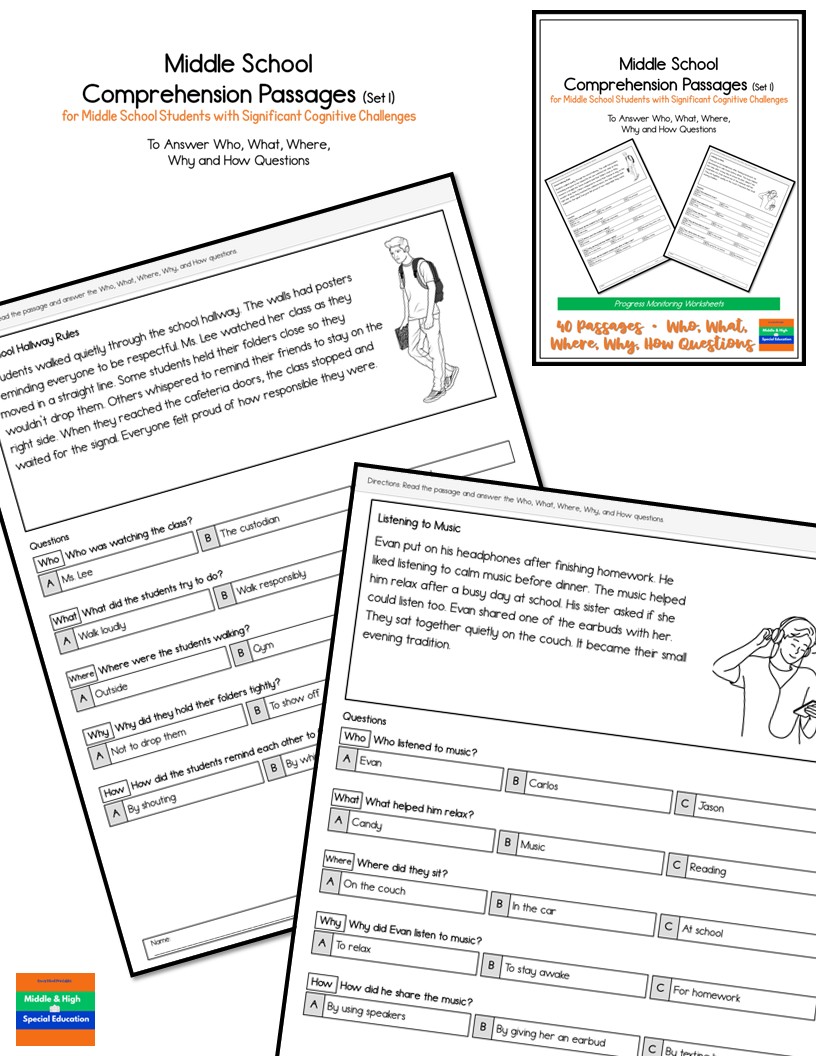
This resource includes 40 passages with structured WH-question worksheets, perfect for progress monitoring in special education, speech-language therapy, and intervention settings. Made for students with intensive needs. Each page features a short passage followed by five multiple-choice questions targeting Who, What, Where, Why, and How comprehension skills.
Remember, comprehension isn't about finishing a worksheet. It's about helping students understand the world around them one lesson at a time.