
- Details
- Category: Blog
- Hits: 1863
In this day and age, our students are surrounded by technology. Much of their lives exist on some sort of screen. While there is a wide-range of views regarding the pros and cons of technology, there is one thing that has remained consistent: Handwriting is still important!
There is a tremendous amount of educational research that demonstrates the importance of letter recognition and formation to overall reading development. This is why it is so important to spend significant time teaching students to recognize and write letters in kindergarten.
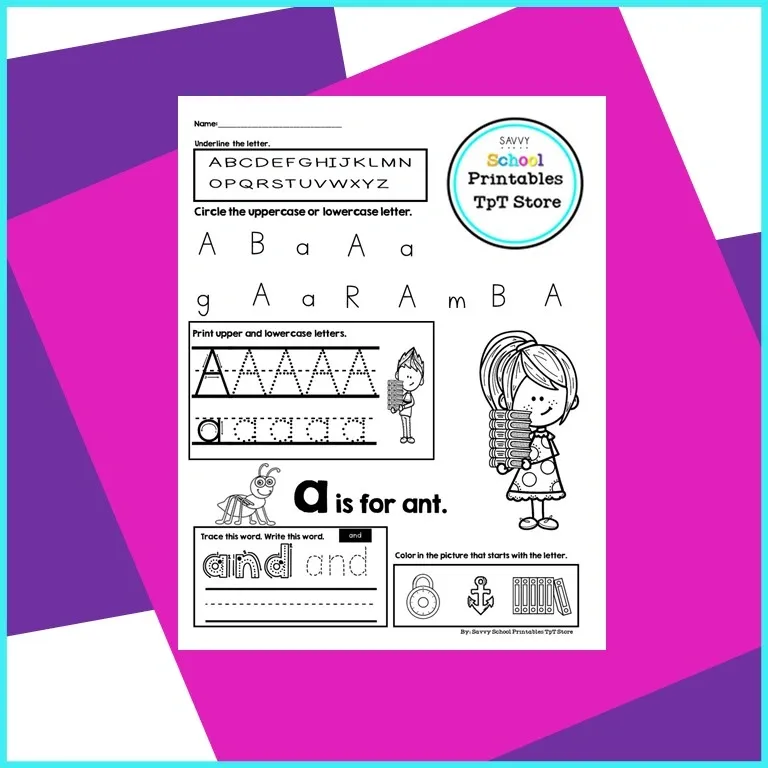
Worksheets for Letter Formation
Teaching Letter Formation
Whether you decide to teach letters in alphabetical order, by importance, or any other order you may use, make sure that the resources you use and strategies you teach are consistent. Decide on an order, and then explicitly teach the formation of each letter. Be sure to teach the letters the same way every time so that the process is clear to students and they are able to easily practice and retain the information.
Once you have explicitly modeled letter formation for your students, it's time to provide them with many opportunities to practice their new skills. Hands-on letter manipulation, games, and worksheets are great ways for students to practice forming and recognizing letters.

Worksheets for Kindergarten Letters
Worksheets for Kindergarten Letters is a fun and engaging way for students to learn and practice letter recognition and formation. This low-prep resource includes printables for 26 letters. For each letter included, there are sections for students to trace, circle and write the letters. There is also a section on each worksheet with images, where students select the image that corresponds with the beginning sound they are practicing.
Teachers can use these printables with their students during whole class instruction and have students start by finger tracing the letters before actually tracing and writing them. These printables are also great for morning work, centers, and sending home with students for extra practice. Because each of the worksheets is formatted the same way, your students will benefit from consistent practice as they’re completing each page.
Click here for these engaging and low-prep kindergarten letters printables to use in your classroom.
Grab your free CVC word journal for your students!!!! CVC Word Journal

- Details
- Category: Blog
- Hits: 1793
Phonics and Phonemic Awareness sound very similar, which is why they often get confused with one another or even lumped together as the same skill. Understanding the difference between phonemic awareness and phonics, and how to utilize both for students' success, is important when teaching phonics and phonemic awareness in your classroom.
What is Phonics?
Phonics relates to the sounds that correspond with letters and letter combinations. When students learn phonics, they learn specific rules that help them to pronounce or “sound” out words and spell words in print. Explicitly teaching and practicing phonics rules can benefit students in reading fluency, comprehension, and spelling skills.
How is Phonemic Awareness Different?
Phonics and Phonemic Awareness go hand in hand, which is why many people ask this question. Phonemic awareness is the ability to identify the individual language sounds in the smallest forms in spoken words, and the ability to manipulate those sounds when appropriate. Examples of phonemic awareness skills include rhyming, isolating specific sounds in words, segmentation, and identifying and counting syllables. Since these skills require lots of repetition and practice, it’s good to have a variety of activities for phonemic awareness to use with your students.
3 Fun Phonemic Awareness Activities
- Baseball - Using baseball as inspiration, teachers can divide students into teams for practicing learning phonics, phonemic awareness and phonological awareness. Teachers can project a baseball diamond on the board to track student progress in answering. Teachers could use a skill like listening to a word with a certain phonics skill and practice by writing it on a whiteboard, and then speaking the word out to the teacher when asked to share their answer. Teachers can use strikes and innings like in baseball, or they can just keep track of points earned.
- Board Game - Turn phonemic awareness practice into a board game! It’s quick and easy to draw a game board on your classroom board or a poster. The game Candyland is a good inspiration for this. For example, if your phonemic awareness goal is to practice rhyming, you could create a bunch of fill in the blank rhyme cards. Students can take turns drawing cards, and when they fill in the blank correctly, they can roll the dice and go the number of spaces they roll on the game board. The first to the finish line could get a piece of candy or get 5 free minutes to do whatever they want on their tablet or device.
- Let’s Get Talking Box - This is a quick and easy way to practice without needing to set aside the time for a full game. Teachers can use a “Let’s Get Talking Box” to practice just about any skill. To do this, teachers make different cards and put them inside a box. Students draw cards from the box and have to answer the card's instructions. For example, a card could say, “Name all the words that start with Th-” or “Say all the words that start with P-” or “How many syllables does the word ‘telegram’ have in it?” Teachers can customize and add in cards as needed depending on the skills students need to work on!
Additional Activities
In addition to the activities described above, there are many phonics and phonemic awareness online games that students can use to practice these skills at school and at home. Using fun activities like these to practice phonics and phonemic awareness will help to boost engagement and will help students to master the skills they need to become confident and capable readers. Click here for printables designed to practice these skills with your students.
Join our mailing list and graby your free cvc word journal!!!

- Details
- Category: Blog
- Hits: 1919
It’s essential for kindergarten teachers to diversify the ways in which they introduce and practice early literacy skills in their classrooms. Without some fun or play, kindergartners can end up bored, checked out, or acting out in the classroom. Added stimulation through games is an excellent way to engage kindergarteners as they learn and practice early literacy skills.
How Games Help Improve Classroom Reading Centers
Classroom reading centers, otherwise known as literacy centers, are meant to allow students to access learning materials independently. In this way, children can be responsible for their learning by selecting from activities, books, and other materials that are set aside separately. Reading centers in the classroom are the perfect way to allow for independent learning time and work on literacy skills.
Including games in reading centers not only gives students the opportunity to practice early literacy skills in a fun and engaging way, it also helps them to develop an early love of reading.
What Kinds of Games Should Be in Classroom Reading Centers?
The best games for kindergarten reading centers incorporate practicing letter recognition, phonics, phonemic awareness and sight words. The best skills to focus on will vary based on the needs of the students in your classroom. With such broad criteria, there are many game options for you to choose from as a teacher. In one quick online search for classroom reading games, you might find hundreds of great ideas for reading games that are appropriate for kindergarteners. To save you time, we’ve compiled a list of our favorites.
4 Fun, Low-Prep Kindergarten Games for Classroom Reading Centers
- Roll and Read Games - A popular option for kindergarten games for reading is roll-and-read games. These are very simple to set up and are well-loved by young children. These games have many variations, but the core principles remain the same. A child will roll a die, and then based on the number that they roll, they will then read the word associated with their result on the dice. For this activity, the student will practice their counting skills (identifying how many dots are on the dice) and their read-aloud skills by practicing sounding out the corresponding word on the page.
- Anything Involving Magnetic Letters - Magnetic letters, also known as “fridge magnet alphabets,” are a favorite amongst kindergarteners. These games are also well-loved by teachers who have an easy time setting up word scrambles and letter identification games on magnetic surfaces such as filing cabinets. Students can unscramble words or spell their own words out with the magnets depending on the setup of the reading game.
- Memory Games with Words - Playing Memory is a classic children’s game that young students love. Pairing this fun activity with sight words and essential vocabulary allows kindergarteners to play one of their favorite games while reading and accessing materials beneficial to their development as young readers. A game like Memory will help students read words aloud, identify them on paper, and exercise their memory by making them focus on which cards they still need to collect.
- Read In Different Voices Activity - This activity is one for a not-so-quiet classroom reading center time, as this game can get quite lively with kindergarteners. For setup, create 2 stacks of cards - 1 stack of cards with the different types of voices you can use while reading and 1 stack of cards with simple sentences for students to read. Students will draw a card from each stack and read the sentence according to the directions on their “voice” card. Some ideas for these cards include “Read in your silly voice,” “Read in a sad voice,” or “Read in an angry voice.” This game can be great fun and practices reading fluency, read-aloud skills, and emotion identification in young students.
Getting Started
There are so many great options for games for kindergarten teachers to implement in classroom reading centers. These kindergarten games for reading help to reinforce early literacy skills and get students excited about learning. Click here to find resources to use with your kindergarten students.
Join our community and get a free CVC Journal Download!


- Details
- Category: Blog
- Hits: 2035
When teaching young students, it can be difficult to know whether or not a student is reading for comprehension. Being able to accurately read words aloud demonstrates fluency, but it doesn’t tell a teacher if the student understands what they’re reading. Reading comprehension is a more advanced skill and requires students to process and understand as they are reading.
Why Reading for Comprehension is Important
Once students have decoding and vocabulary skills, the next step in their journey is reading comprehension. Students need to be taught to connect the words they are reading to thoughts and ideas. Without these connections, a child can read an entire paragraph and have no idea what it was about. If comprehension isn’t taught early and properly, children can develop a negative relationship with reading and try to avoid the action altogether.
3 Tips for Teaching Reading Comprehension
- Create a Safe Space - Like all skills, reading comprehension will develop at a different rate for each of the students in your classroom. It’s crucial that they feel comfortable telling you when they don’t understand certain words or are becoming frustrated. Without this communication, students are more likely to fall behind or stop trying.
- Use Visual Aids - Visual aids reign supreme in all subjects, and reading for comprehension is no different. For younger students, it can be as simple as showing them a picture of an animal and having them write out the name of the animal. For a more advanced strategy, show your students a picture of a house or a slice of pizza and have them write a short sentence about it. These exercises will help your students recall words that they associate with the ideas and concepts they want to express.
- “Cloze” Task - This activity is a great place to start with students at any reading level. Simply choose a generic sentence at their reading level and remove one of the words. Ask your students to pull a word from memory and insert it into the sentence. It can be a word as simple as “dog” or as challenging as “hospital” or “helicopter."
3 Easy Ways to Check for Understanding
- Have Students Summarize What They Read - Once your students can read and conceptualize full sentences, have them read small paragraphs and summarize what they read. This is a great activity to do with small groups and can inspire conversations that further deepen students’ connections with the text.
- Ask Specific Questions - While your students are reading, ask them specific questions about what they’re reading. For instance, if they’re reading a paragraph about a man who is walking his big dog Spot, wait for them to finish and then ask them what size the dog was.
- Have Students Follow Written Instructions - A great way to check your class’s progress as a whole is to put written directions on the board and observe whether or not your students can follow them. Based on the complexity of the directions, you can gauge whether students comprehend the directions or need additional support.
Additional Resources
Reading comprehension is an important skill that your students will continue to strengthen and develop in every grade. A strong foundation in the early grades helps students to begin making important connections as they read and to develop a love of reading. For engaging printables designed to help you students practice reading comprehension skills, click here.
Join us for more strategies and information below...

- Details
- Category: Blog
- Hits: 2077
Teaching vowel teams can be a challenging task, but it is an essential component of learning to read and write proficiently. Learning to recognize and understand vowel teams can greatly improve a child's reading and writing skills. Let’s explore some effective strategies for teaching vowel teams to help your students become confident and competent readers and writers.
What Are Vowel Teams?
Vowel teams are combinations of two or more vowels that work together to create a single sound in a word. When two or more vowels are next to each other, they can form a vowel team, and produce a unique sound that is different from the individual sounds of each vowel. Examples of common vowel teams include "ai," "ee," "oa," "ou," and "ie." Vowel teams can be challenging for young readers to recognize and understand. However, mastering the recognition and use of vowel teams is a critical component of developing strong reading and writing skills.
When Should You Teach Vowel Teams?
Typically, vowel teams are introduced in the first grade, but this can vary depending on students’ readiness. Teachers should begin teaching vowel teams once students have a good grasp of basic phonics and decoding skills and should introduce vowel teams gradually, starting with simple vowel combinations and gradually moving on to more complex combinations. It's essential to provide many opportunities for students to practice reading and writing words containing vowel teams, both in isolation and in context, to ensure that they fully understand the rules and patterns.
5 Strategies for How to Teach Students Vowel Teams
- Word Sorting Activities - Students need to have a strong grasp of what individual vowels are before vowel teams are introduced in the mix. A great way to do this is through word sorting activities. Have students sort words that contain vowel teams, such as "boat" or "coin", into a separate category from words that only contain a single vowel, such as "cat" or "dog". This will help them begin to recognize words that contain vowel teams and understand the concept of a diphthong.
- Word Families - Another effective teaching strategy is to use word families. Word families are groups of words that have the same ending, such as - at, -an, and -ot. These groups are great for teaching vowel teams because they allow students to see the different ways that vowel teams can be used in words. For example, the -oat word family includes words such as "boat", "coat", "goat", and "float". This helps students to recognize patterns in words and understand how vowel teams are used to make different words.
- Visual Aids - Having a set of word cards and pictures in the classroom can help your students make simple associations. Try to have students match word cards that contain vowel teams, such as "boat" or "coin", to pictures that depict the corresponding word. This allows students to see the word in print and connect it with the corresponding image, which helps them to understand how vowel teams are used in words.
- Poems and Tongue Twisters - Poems and tongue twisters often repeat certain sounds, like the ones vowel teams make. Print copies of a poem or tongue twisters that emphasizes several vowel teams and pass them to your students. As you read the page aloud, have your students highlight the repeating vowel team sounds they hear.
- Anchor Charts - Teachers can use anchor charts as another way to visually reinforce vowel teams. Anchor charts can be a reminder of letter combinations, the sounds they produce, as well as the words that include them. Try to incorporate creativity into the anchor charts by finding ways to visually differentiate the vowel teams from other letters.
Avoid this Common Strategy When Teaching Vowel Teams
Avoid the clichés! Have you ever heard the phrase, “When two vowels go walking, the first one does the talking?” While it does cleverly rhyme and is true for some vowel teams, it doesn’t apply to them all. Because there are so many exceptions and quirky rules for vowel teams, it’s best to avoid this phrase in the first palace.
Getting Started with Vowel Teams
By incorporating a variety of strategies such as the ones described above, teachers can help students develop a strong understanding of vowel teams and their associated sounds. Additionally, providing opportunities for students to practice using vowel teams in context through reading and writing activities can further reinforce their learning. With patience, persistence, and creativity, teachers can help their students master this important skill as part of their journey to become confident and effective readers and writers. For printables from my store to use with your students as you teach vowel teams, click here.