
- Category: Blog
- Hits: 1937
Building fluency in all grades is important, but it’s especially critical in 3rd grade. By the time students reach 3rd grade, they should ideally have acquired the skills and confidence to read independently. This is also the year that testing expectations shift from tests being read aloud to students to students reading and completing their tests independently. This transition tends to be very challenging for students, which is why continuing to build fluency is so significant in 3rd grade.
What is Fluency & What Does Fluency Tell Us?
Fluency refers to the quality of the reading a person is doing. Students that struggle with fluency may read very slowly, make a lot of mistakes or lack expression when they read aloud. A student is proficient in fluency if their reading is smooth and they make little to no errors when reading. Fluency screeners give teachers insight into how fluency could be inhibiting a student’s reading comprehension and help teachers to pinpoint which skills need additional instruction or practice.
Activities to Improve Fluency
- A great time to check-in and practice fluency with students one-on-one is when the whole class is engaged in reading or doing independent work. Teachers can meet with students individually and listen to them “whisper read” for 3-5 minutes at a time. This provides the opportunity for beneficial practice, informal assessment and feedback in a very short period of time.
- Center time also provides an additional opportunity for teachers to focus on fluency. The teacher can select fluency passages at the appropriate level for each student and check-in with each student briefly. At that check-in, each student will read through their passage while the teacher takes a running record. This provides practice for the student as well as important data the teacher can use to structure future instruction.
It’s important for teachers to build time for fluency practice into the school day because continuous practice and teacher feedback are the keys to improving reading fluency. The time invested in building fluency will benefit your students both in 3rd grade and beyond. Click here to find resources to use for fluency practice with your students.


- Category: Blog
- Hits: 2076
What are Vowel Teams?
Vowel Teams are two side-by-side vowels that come together to make one sound. Examples of vowel teams are /ea/ in the word eat and /ie/ in the word pie. Unfortunately vowel teams don’t always represent the same sound in every word, which can make them tricky, especially for early readers. For example, /ea/ can have the long e sound like in the word eat. But it can also represent different sounds like in the words head and break.
Why Should You Teach Vowel Teams?
Students will need to have a general understanding of short vowel sounds and long vowel sounds before being introduced to vowel teams, because vowel teams add an extra level of complexity. Once students have been taught about vowel teams and have learned examples of common words that contain them, their reading fluency will improve significantly.
Learning vowel teams can also help to reduce spelling errors. This is because students that understand vowel teams have a better understanding of short vowel sounds, long vowel sounds and the unique sounds produced by common vowel teams. This connection between the sounds and the letter combination helps students to spell more accurately based on how a word sounds.
Understanding Vowel Teams
Vowel teams are considered digraphs because 2 letters produce one sound. Some vowel teams are considered diphthongs, since 2 vowels with their own sounds are combined to form a new sound. For example /oi/ in the word boil.
A common phrase that teachers use when talking about vowel teams is “when two vowels go out walking, the first one does the talking.” While this is catchy it can be damaging to vowel teams overall, because it is often not true and can lead to mistakes and confusion.
3 Tips for Teaching Vowel Teams
- Have a separate visual of the most common words that include tricky vowel sounds. Make sure it’s easy for students to see, so they can reference it as needed. Reinforcement and practice are crucial to helping your students to master vowel teams.
- Make practicing fun! Set up a magnet spelling station with your vowel team words. This gives students hands-on practice building, spelling and reading words that contain vowel teams.
- Pause and point out vowel teams when reading aloud to the class. Making the connection between the words learned individually and finding them in engaging text makes learning relevant and more memorable.
Bonus Tip! Practice vowel teams on paper with worksheets that include the images associated with the words. These images are especially helpful for young learners because they tend to know the pronunciation and meaning of many more words than they can read or spell. Associating familiar images to the words on paper, creates additional opportunities for students to make important connections and increase their reading vocabulary.
I've got something that could help with this.
These printables are designed specifically to help your students practice vowel teams! Enjoy.

- Category: Blog
- Hits: 1715
Encouraging students to draw pictures at the beginning of the writing process inspires them to imagine and express their ideas. Drawing helps students to organize their ideas and to add lots of details, which tends to make the actual writing part of the process much easier and more enjoyable. Although drawing does require setting aside some extra time, the benefits are well worth the time investment.
Benefits of Drawing Before Writing
Drawing inspires children to think creatively. As children draw their ideas, they begin to tell a story. As they draw, they make decisions about important details related to the characters, the setting and the plot. A detailed drawing can help students to organize their ideas visually before they need to commit it to words on a page.
Many students struggle to generate words and ideas when they are asked to write. Young writers often know many more words than they can write, which allows them to draw details that they may not initially be able to describe through writing. Starting with a drawing can make the process less stressful, and it makes writing easier because there is a detailed picture to write about.
3 Ways to Incorporate Drawing in the Writing Process
- Younger learners love using “story paper,” which has a space for a drawing at the top and lines for writing at the bottom. Click here for printable “story paper” to use with your students.

With this type of paper, teachers simply provide students with a writing prompt and then allow students time to draw their ideas before writing. - If students are being asked to write a story, using empty comic strips as a template can be a fun way to get started. Students would draw the events of their story in each of the comic strip boxes. This helps students to plan and order the story as well as to visualize the details they will want to include in their writing. The illustrated comic strips serve as helpful outlines for students when they begin writing.
- In situations where a graphic organizer like a Venn Diagram or T-chart is being used, the format can be modified to include drawings. Students could draw pictures to represent their ideas instead of writing in the organizer, or the organizer could be enlarged to make space for both small drawings and text. This is especially helpful once topics become more complex in the older grades.
Getting Started
Incorporating drawing with writing activities in the classroom is simple. The teacher should share the writing prompt and ask the students to start by drawing a picture or pictures to represent their answers. Once their answers are drawn, students should then be given an opportunity to share their drawings with partners or small groups. These conversations can help to increase students’ vocabulary and add additional details, both of which will be helpful when students are writing.
By spending just a few extra minutes of class time drawing before students begin writing activities, teachers can drastically improve the experience for students. Students will have an easier time getting started, will be more confident in their work, and will be able to produce better writing overall. Not needing the larget size paper? I have a smaller size with 2 on a page for you. To get started, click here for a link to free printable handwriting paper.
Join our community to get tips and ideas for teaching!

- Category: Blog
- Hits: 1757
The Importance of CVC Word Practice
Once students have learned letter sounds, reading CVC words gives them practice combining those sounds in predictable patterns to form simple and familiar words (consonant-vowel-consonant). And once they have sounded out CVC words, students can make connections to corresponding images or actual items in the classroom. These connections help them to build their reading fluency and spelling skill. It also helps to build their reading confidence.♥️
Introducing: CVC Spell and Write Words Activity for Word Work
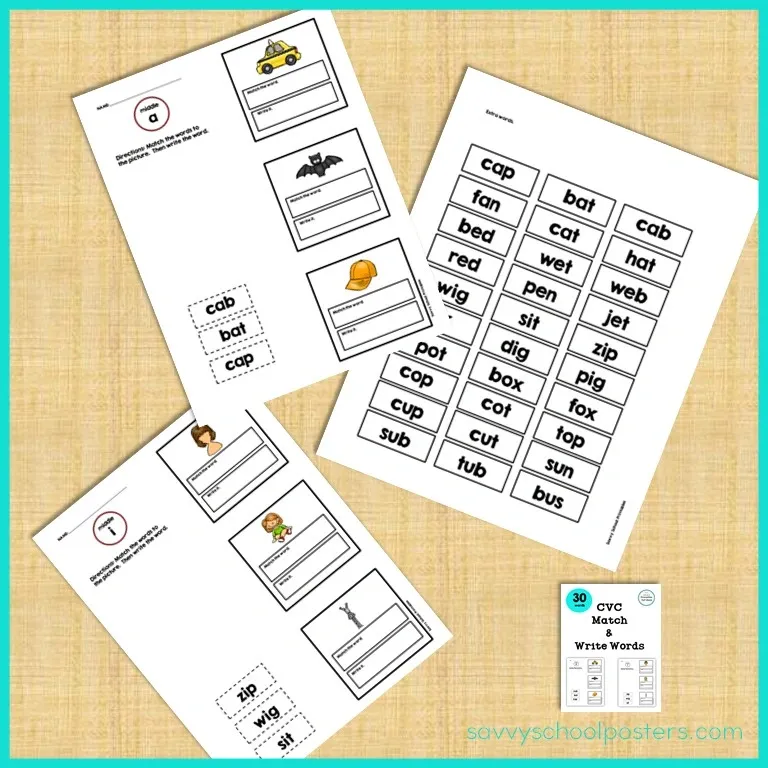
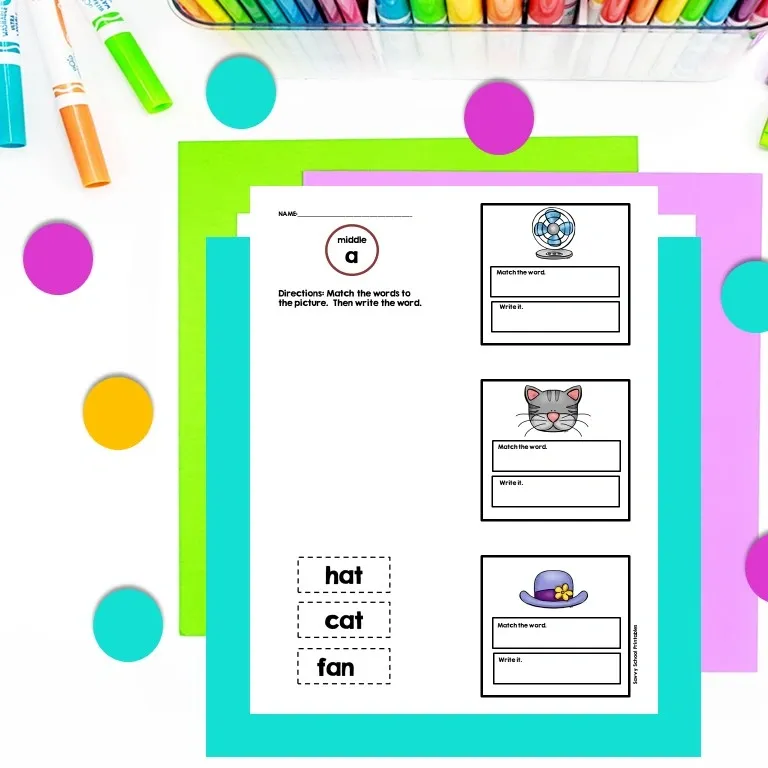
CVC Spell and Write Words Activity for Word Work is an excellent resource that contains hands-on and interactive activities for CVC word practice in the classroom. In each activity, students will cut out and match each CVC word to the corresponding picture and then practice writing the word on the paper. The directions are simple and easy for students to follow, which makes them great for both teacher guided and independent work.
This resource is geared towards pre-K, kindergarten and 1st grade learners and includes practice for the following CVC words: cap, bat, cab, fan, cat, hat, bed, wet, web, red, pen, jet, wig, sit, dig, pig, pot, box, fox, cop, cot, top, cup, cut, sun, sub, tub, bus.
*Teacher Tip: To make your CVC word labels last even longer, laminate each word so students can have fun matching words again and again!
3 Ways to Use CVC Spell and Write Words Activity for Word Work in Your Classroom
- Teacher-led small groups or guided reading groups are a great way to introduce and monitor this activity while students are first learning how to complete the steps. It can also be used as a formative assessment for CVC word mastery by pulling students back to these groups periodically and monitoring how they are doing with the activity.
- Because the steps are so simple and easy to follow, these activities are great for centers and literacy tubs. Once students know the steps, they can access these activities independently. This provides important practice and boosts students’ confidence.
- Having the materials for these activities handy in an “early finishers bin” is a great way to offer additional valuable practice for students that have already finished their assigned work. Again, because the steps are so simple, students can work on this independently without needing teacher support.
Getting Started
Click HERE to scoop up my CVC Spell and Write Words Activity for Word Work to use in your own classroom. While you’re there, you will definitely want to check out the other awesome worksheets for CVC words in my store too.

- Category: Blog
- Hits: 1901
CVC Worksheets
Why is it so Important to Practice CVC Words?
Once young learners have learned the shapes and sounds of individual letters in the alphabet, it’s time for them to start combining the letter sounds to make simple words. As they combine letters (consonant-vowel-consonant) to form words, they also begin to associate the written words with words they are familiar with hearing and speaking. CVC word practice is very important for early readers, and it requires a lot of repetition. Fortunately, practicing CVC words can be fun!
CVC Words Worksheets Make Practice Fun
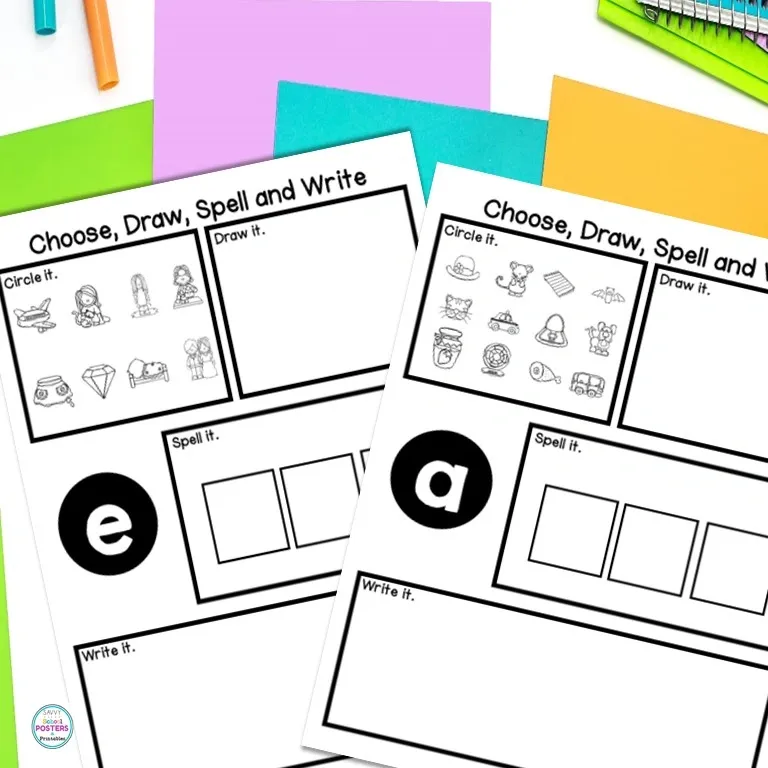
CVC Words Worksheets provide engaging and interactive CVC word practice for your students. There are 2 worksheets for each vowel (a,e,i,o,u) as well as letter tiles for spelling out the words. To complete each worksheet, students first circle a focus word. Next they draw it, use the tiles to spell it, and then finally write the word.
These worksheets are perfect for kindergarteners and first graders. There are so many CVC words included that this will be a resource you can use all year. The following CVC words are included for each vowel:
A-hat, rat, mat, bat, cat, cab, bag, wag, jam, fan, ham, van, sad, dad, mad, pad, car, bar, jar, map, tap, gap, fat
E- leg, beg, net, ten, pen, men, hen, jet, pet, wet, hem, gem, bed, wed
I- zip, lip, hip, dip, lid, kid, six, mix, sit, pit, kit, hit, bib, rib, wig, big, pig, dig, fig, fin, bin, pin, win
O- top, pop, cob, sob, log, fog, hog, jog, mop, cop, hop, fox, box, pod, rod, dot, pot, hot, cot, jot
U- sub, tub, cub, gum, sun, bun, nun, run, nut, hunt, cut, cup, rug, mug, bus, pup, mud, bud, bug, sum
3 Tips for Using CVC Words Worksheets in Your Classroom
- Once you have instructed students on how to use the CVC Words Worksheets and given them the opportunity to practice, they will be able to do additional practice without your direct instruction. You can add CVC Word Worksheets to your centers, guided reading, literacy tubs, small groups, or early finishers bin.
- Try laminating, or placing the CVC worksheets in sheet protectors, so they can be used over and over. Then, let students use dry erase markers to complete the activities and erase when they are finished.
- If you decide not to laminate the worksheets, you can allow students to express their creativity and personalize their worksheets by coloring in the tiles afterward.
Getting Started
You can simplify your planning AND help your students to practice their CVC words in a fun and interactive way by clicking HERE and scooping up my CVC Words Worksheets to use in your own classroom. It’s a win for all!
While you’re in my TPT store, you will definitely want to check out the other awesome worksheets for CVC words in my store too. Click HERE to see some of my favorites. ♥️
Follow up with us using email!!!